


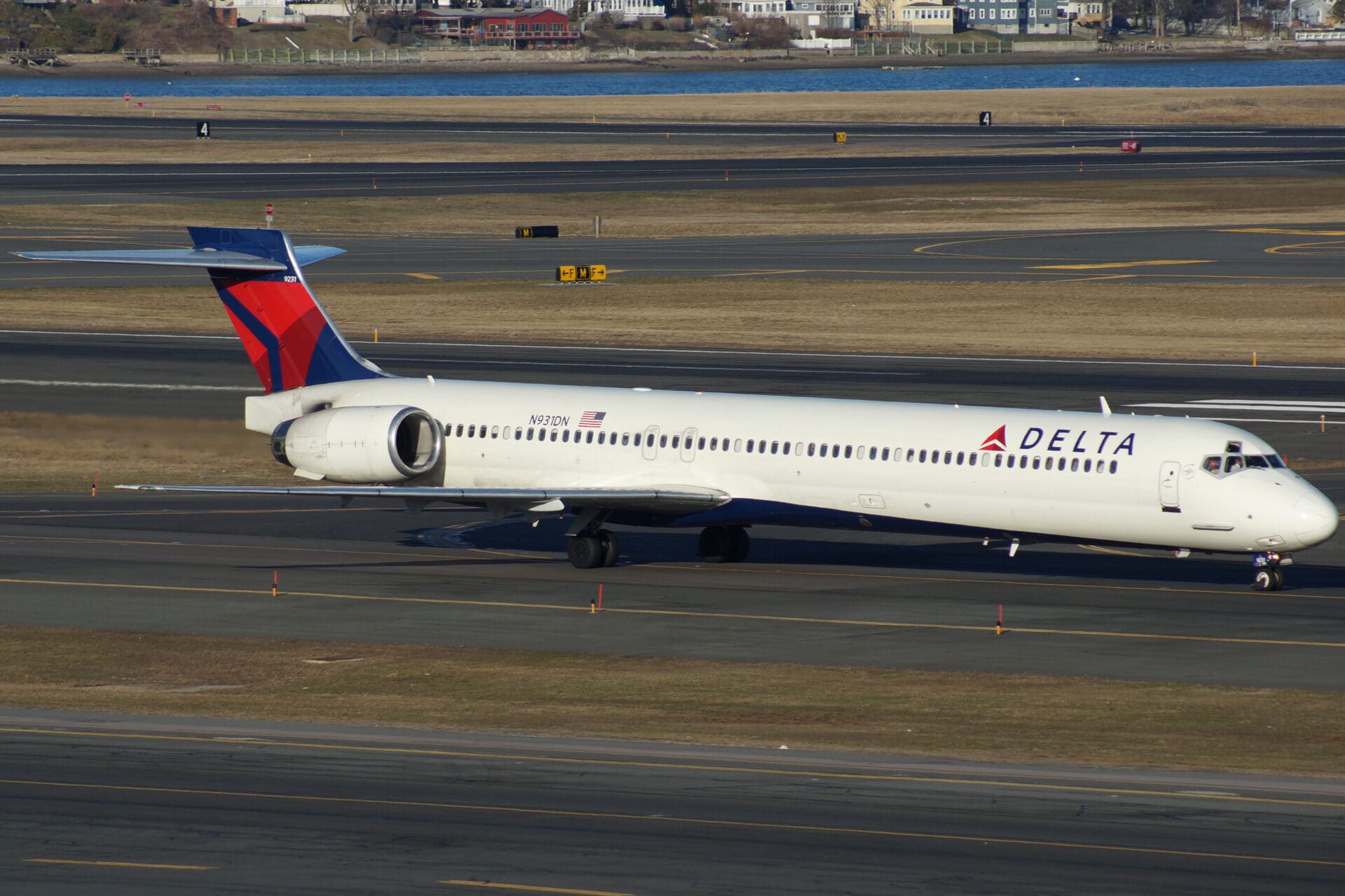

Delta quietly removing MD-90s from its fleet
During the second quarter of this year, Delta Airlines has discretely been removing Boeing/McDonnell Douglas MD-90s from its fleet, following plans to adjust the size of aircraft on certain routes.
The airline removed 12 of the aircraft during the period, leaving 53 left in their fleet. All of the retired frames were ex China Southern that were acquired by Delta in 2011.
Delta has their MD-90s configured with 158 seats in a three-class configuration. All first class and Comfort+ seats have 110v power outlets and USB charging ports.
MD-88s are also in the process of being retired in order to be replaced with larger, more efficient aircraft such as the Boeing 737-900 and Airbus A321.
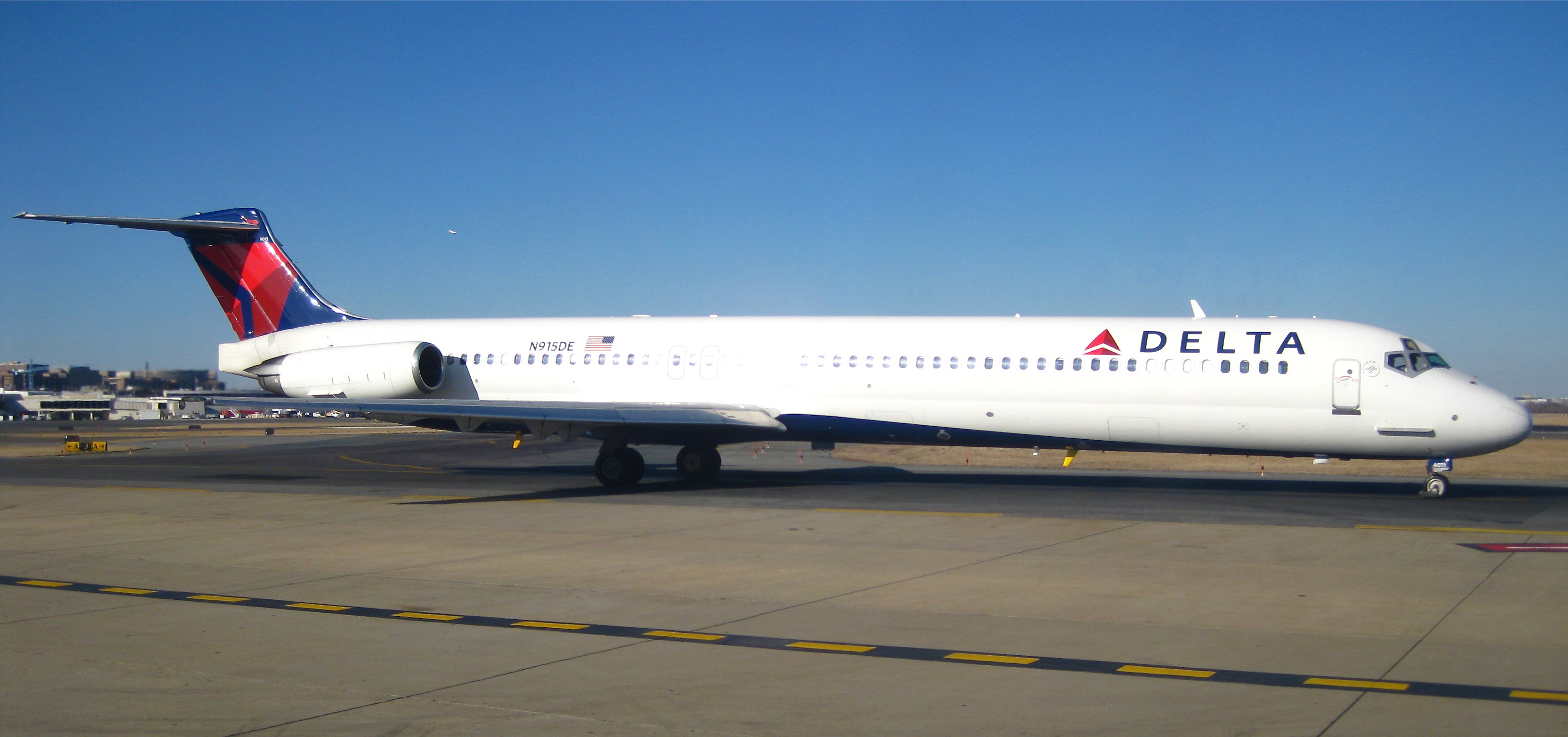
Although the MD-90s are more fuel efficient than the MD-88s, their parts availability is not up to standard with other aircraft, primarily because only 116 were built. With Delta being the only operator of the type as of October 2017, sourcing parts outside of their possession is hard work and maintenance costs are climbing according to engineers familiar with the situation.
Henry Hartveldt, president and travel industry analyst at the Atmosphere Research Group, mentioned that the decision to remove the aircraft early could be based on the aircraft’s position in life in the following statement to FlightGlobal:
“It’s likely that these are aircraft that have reached a certain stage in longevity where maintenance requirements are worth more than the value of the asset.”
Despite the part sourcing issues, the IAE V2500 engines on early retirement aircraft can be parted out and used to support the remaining MD-90s where specific parts cannot be sourced.
Delta will receive 70 aircraft this, of which, some have been delivered, so the departure of the MD-90s won’t effect them much in terms of keeping passenger loads and operating routes.
It is not known when Delta will retire their last MD-90 but they remain keen on sending off their last MD-88 by 2020.







This story is devoid of any actual facts, doesn’t cite any actual sources at Delta, and contains blatantly incorrect information. Not only that, but it’s also bordering on a blatant rip-off of a similar story posted by Flight Global two days prior to this story appearing on Sam’s site. It even contains some of the exact same text from the Flight Global story. There is no way that was an accident.
I’ve discussed this story (and the Flight Global story) with several friends at Delta TechOps in Atlanta over the weekend, as well as a few in management at Delta HQ…and everyone agrees that no one in the ‘aviation media’ realm seems to have a clue what they’re talking about when it comes to what is actually going on with the remaining McDonnell-Douglas fleet at Delta.
As for the actual truth…
Every time someone takes note of an MD-88 or an MD-90 heading to SBD or MZJ, they just assume that it is finished – and this is certainly not the case. The only place Delta will send a bird these days where it is guaranteed to never leave under its own power is BYH.
Delta isn’t responding to the questions about retiring the MD-90’s that Flight Global posed to them because…they’re not retiring the MD-90’s yet.
As has been discussed here multiple times over the last few months, only a few of the MD-90’s that have been parked at this point are going to become parts birds and are truly retired. The rest (parked at SBD and ATL) are currently stored without their engines because they are being overhauled in Christchurch, New Zealand, which is home to the only shop that will overhaul the version of the V2500 that Delta uses on their MD-90’s. Fortunately, that’s the only bird in the fleet that uses that engine, so they don’t have to go to extremes like this to overhaul engines for any other ships. (Correction to this story – “support the remaining MD-90s and A320s” doesn’t apply as Delta’s A319/320 fleet uses CFM-56 engines, not the V2500 used by jetBlue and other airlines.)
Finding parts for the MD-90 isn’t nearly as difficult as this story implies as many are interchangeable with their MD-88’s. Delta has parked enough of their oldest MD-88’s over the last few months -and a few MD-90’s that are becoming parts donors and won’t be coming back to life- that spare parts aren’t difficult for them to come by.
Looking these birds up in the system shows them as being in long-term (temporary) storage – not retired. Once they have their engines re-installed after overhaul, they will be returning to service.
As for the MD-88’s (another topic that has been discussed for months) – the birds that are being retired to SBD are due for heavy checks, which they will not be receiving. That’s the determining factor for the -88 fleet at this point – if they’re due for a heavy check, they’re done. If they were one of the most recent to receive a heavy check, they’ll be around for a few more years and are having ADS-B and GPS installed in either Atlanta or Mexico.
At least 34 of the ‘newest’ birds in the -88 fleet, as well as nearly all of the -90’s, will all be around beyond the 2020 ADS-B mandate, which is why they’re taking the time and money to install it in those birds. The -88’s require the ADS-B and GPS install, while the -90’s only require the ADS-B install as they already have GPS. The ADS-B hardware for the -90 is nothing more than a modified version of the same gear used on the -88.
Thank you for your feedback. As for it being related to FlightGlobal, that was one of three sources used to gather information. The other two were from Delta and related servicing centers. My apologies if it seems incorrect and I will take account for the engine mix up as that was definitely a simple mistake by me – I’ll correct that now. Regarding parts sourcing difficulties that you suggest, from what I’ve heard from people involved in the situation, sourcing parts is hard if they’re outside of Delta’s stockpile. I understand you’re upset by the article and its content. I’ll ensure that it won’t occur again in the future.
Love the Mad Dogs, of all variants. Yeah I am an AV Geek so my sentiments can be dismissed. But I will be far from the only sad person when the last of the mainline T-tails leaves scheduled commercial service. Love the clean wing, the 2-3 configuration in coach, and the engine noise in the back of the bus (whereas it is whisper quiet in first class). The faint smell of Jet A in the cabin, the visible smoke trail from the low bypass PW JT8D’s (cue the angry leftists), the flatline noise that is omnipresent in the background anytime a crew member speaks via the PA…good stuff. DL flies a lot of these in and out of my home airport, so I have come to associate the plane with a homey feeling. Yeah it’s old, but modernity isn’t everything. The amazing thing is that as old as the planes are, the basic design is far older. Yet these birds have somehow managed to remain economically viable through several decades. When it’s gone, the planes taxiing around our airports are going to look a lot less diverse…just a bunch of boring twinjets with engines slung under the wings. T-tails will be relegated to the little regional jets, and even there they are likely on borrowed time.
What, Lance? Northwest only had a small number of MD-80’s, no MD-88’s.
Thank god. NW was in the process of scrapping the MD88s before the merger, then DL decided to keep them. These planes are loud — for passengers and those who live near the airport. They won’t be missed by anyone other than av geeks and can’t be gone soon enough.
Man kick rocks these are great McDonnell Douglas aircraft. So what they’re loud. They are paid for and reliable. This is nothing more than a move to suffice Airbus people.
NWA didn’t have any MD-88’s in their fleet at the time of the merger, Lance. In fact, NWA only has a few MD-80’s ever and that was many, many years ago. At the time of the merger, NWA had a large fleet of DC-9-30’s, seven DC-9-40’s, and 34 DC-9-50’s – the -50’s being the only DC-9’s acquired from NWA to actually be painted in Delta’s livery and have GoGo internet installed.
All of the MD-88’s in Delta’s fleet were Delta’s bird more than a decade before the NWA merger was even thought of. Delta took delivery of almost all of them brand new in the late-80’s to late-90’s.
As for the -88’s and -90’s being retired… That’s where this blog post becomes factually incorrect. See the comment I post on this story for details.
Actually, I have found the MD80s fairly quiet inside. Especially up front where you can hardly hear the engines revving up or down.
Yes, the MD80 by today’s standards is loud on take off outside. It’s particularly loud outside during the brief period of reverse thrust after touchdown, but the MD80s landing approach noise is not too bad. It’s a late 70s design yet the MD80 still meets Stage III noise standards…if only barely.
Granted, DL’s MD90s and especially the DL MD88s are in general not being updated with the latest cabin features due to their upcoming retirements. Also, IIRC, the MD narrow body jets have some trouble physically accepting some cabin upgrades like AVOD. Thus, even DL’s 717s which are not going anywhere soon won’t get some cabin features. DL’s 717s are meant for shorter flights anyway, and the DL MD88s are quickly being relegated to mostly short hops only out of ATL. Still, it’s understandable how some customers on longer flights would choose other DL planes with more features… or other airlines.
As Derec touched on already, the only MD80s NW operated were a small number of ex-Republic MD82s and these were phased out just before the DL merger. NW had plenty of A320s and DC9s, and the few MD82s around were a sub-type NW eliminated to simplify maintenance supplies and pilot staffing procedures. NW never operated the MD88 (the MD82 and MD88 are from the same basic MD80 family).
As others have mentioned, NW used MD-82s but never MD-88s. But to add to previous posts, records also show DL never operated any of the MD-82s that NW had.
It turns out NW had only 9 MD-82s (no more than 8 at any one time). Eight were ex-Republic, a ninth ex-Muse Air. NW was in the process of acquiring the ex-Muse Air bird when one of the ex-Republic planes was tragically lost at DTW (1987) when the flaps/slats were improperly set for takeoff.
To further build on a previous point, the MD “80” name is more of a generic designation. The MD-80 family actually consists of the MD-81, MD-82, MD-83, MD-87, and MD-88.
As much as I love airplanes, this plane needs to be retired. I often travel ATL-CLE to see my parents and DL only flies the 88’s and 90’s on that route. It’s so dated and I am very thankful that they are making efforts to remove them from the fleet. There is nothing modern about this plane.