






A serious cracking issue has been identified on some Boeing 737 Next Generation aircraft, prompting the manufacturer to contact airlines.
The Federal Aviation Administration issued a warning to airlines on Friday the 27th of September, requesting that they conduct inspections for structural cracking and apply appropriate repairs.
Boeing engineers and safety authorities are currently working to determine exactly how many aircraft are affected by the issue, after several instances were found on aircraft around the world.
The part subject to cracking is called a pickle fork, which is responsible for holding a 737s wing structure to the fuselage. Additionally, a pickle fork also manages the large amount of stress, torque and aerodynamic forces around the wing and aircraft body joint.
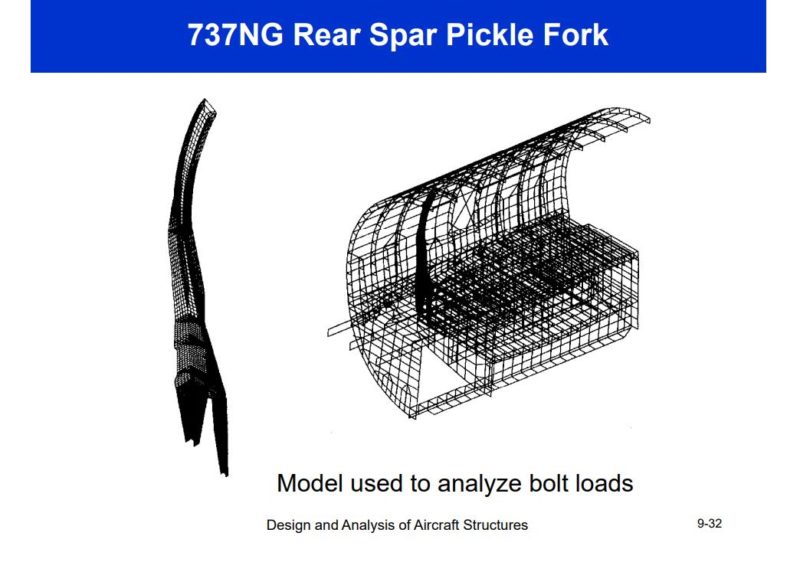
Pickle forks are designed to last the entire lifespan of an aircraft, so for the Boeing 737 NG it should last around 90,000 cycles. Should a pickle fork fail, a serious accident could occur, easily bringing down an aircraft, resulting in the deaths of many.
What caught the attention of engineers was a fairly young 737 NG with around 35,000 cycles that had seriously cracked pickle forks.
An engineer in contact with KOMO News who elected to remain anonymous reflected on the situation in the following statement:
“It’s unusual to have a crack in the pickle fork. It’s not designed to crack that way at all. Period.”
Boeing has acknowledged the problem and reaffirms only a small number of aircraft have been found with cracked pickle forks during inspections. It is also understood that this issue does not affect P-8 Poseidon and 737 MAX aircraft.
Airlines conducting inspections are required to contact the FAA and their respective authorities immediately to present their findings.
Even the smallest cracks are to be taken seriously; fatigue cracks grow in size every flight, increasing the chances of a catastrophic failure.
The Boeing 737 NG was introduced in 1997 and is the third revision of the original 737. Comprising of the -600, -700, -800 and -900 variants with additional sub-variants in the mix, the 737 NG last rolled off the production line for the final time in June 2019.
No mandatory inspections have been ordered by governments yet, as not enough data is available to completely determine a maintenance plan.
An investigation has been opened that will look into the cause, effect and remedies.







This is a concerning development. The Boeing 737 NG is a widely used aircraft, and any structural issues could have serious implications for passenger safety and the airline industry. It’s crucial for Boeing to address these cracking problems immediately and ensure all affected planes are inspected and repaired. Safety must be the top priority to maintain trust in air travel.
Thanks, Aaron for this awareness article. But I don’t know why people are using Boeing 737 after happening lot of crash!
Your article very helpful, I like to visit your website for reading those articles.BOEING 737 is the worst airplane in this present world.
A very common defect found on Boeing 767. Nothing much to worry about. Just wait for Boeing to issue an SB to carry out replacement or reinforcement of the pickle fork
Boing is no longer a name that brings piece of mind. Every month we are hit with another surprising bad news about their airplanes.
I fly over 150K every year and until recently never felt uneasy.
I’m about to fly from MIA to DEN on a 737-800 and I must confess I do not feel completely safe.
BOEING 737 is the worst airplane in this modern world. The world is going forward but BOEING is going backward.