


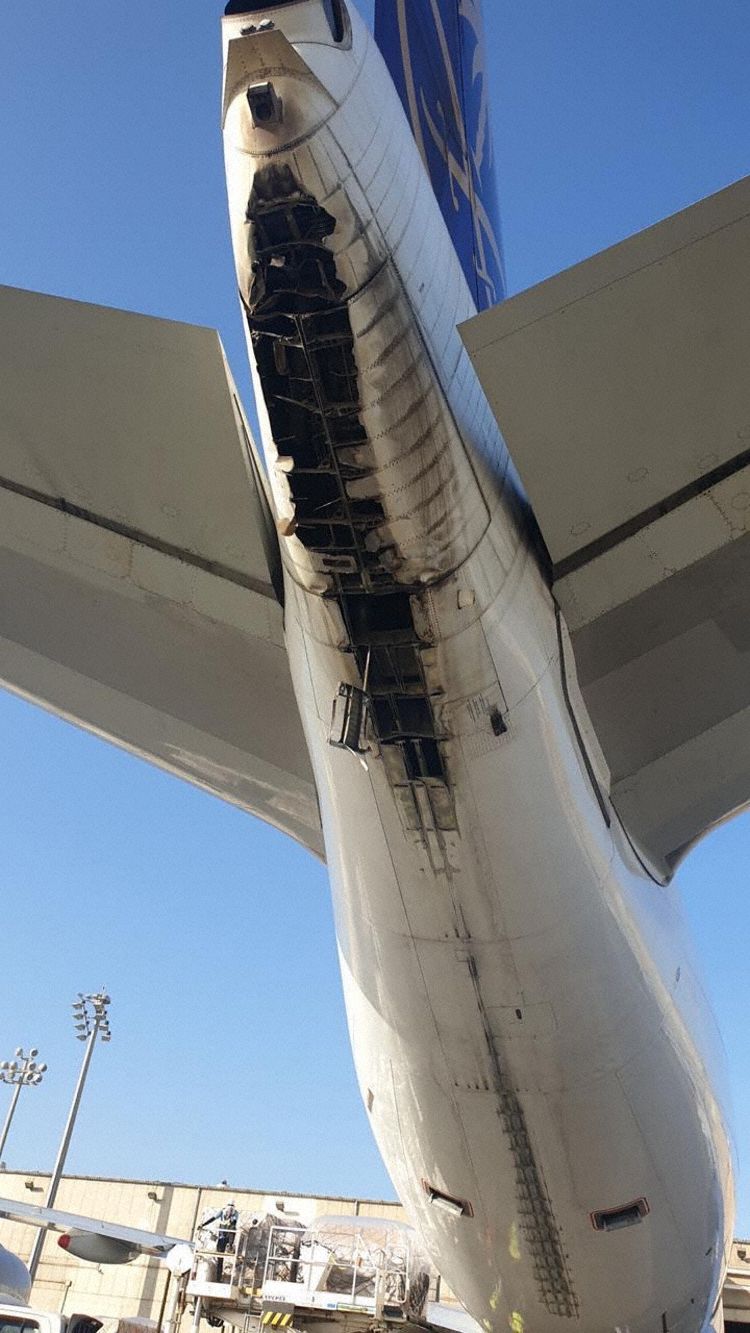

The tail section of a Saudia Cargo Boeing 747-400 Freighter, operated by ACT Airlines (MyCargo Airlines), was torn open after it struck the runway during its takeoff run out of Dammam King Fahd Airport, on the 1st of February 2020.
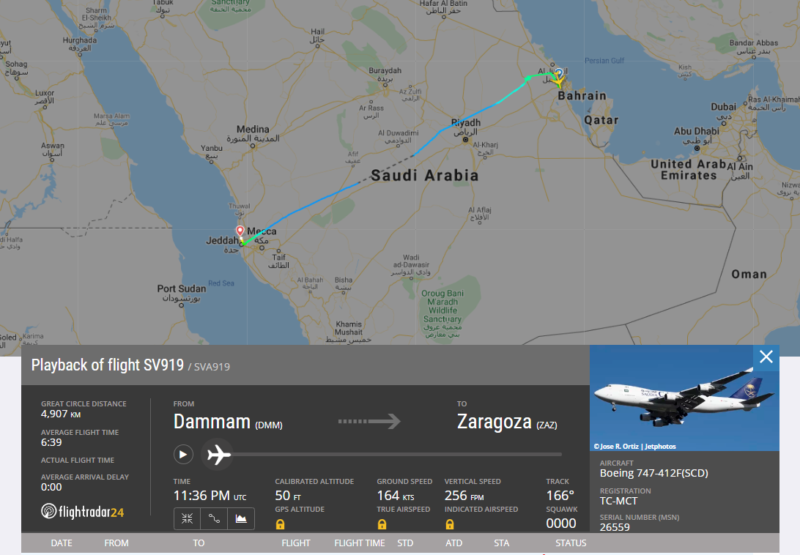
Registered TC-MCT, the aircraft was performing flight SV919 from Dammam King Fahd Airport, Saudi Arabia to Zaragoza Airport, Spain when during departure from runway 16R the tail struck the ground.
Noticing the tail strike, the pilots levelled the aircraft off at 7,000 feet to assess the situation; they then commenced a climb to 10,000, 15,000 and then later 18,000 feet.
Rather than returning to Dammam the pilots elected to divert to Jeddah, to perform a successful landing around two hours and fifty minutes after their departure.
Photos of the incident show significant damage to the underside of the tail section, where the runway surface tore open the aluminium skin and ground it away.
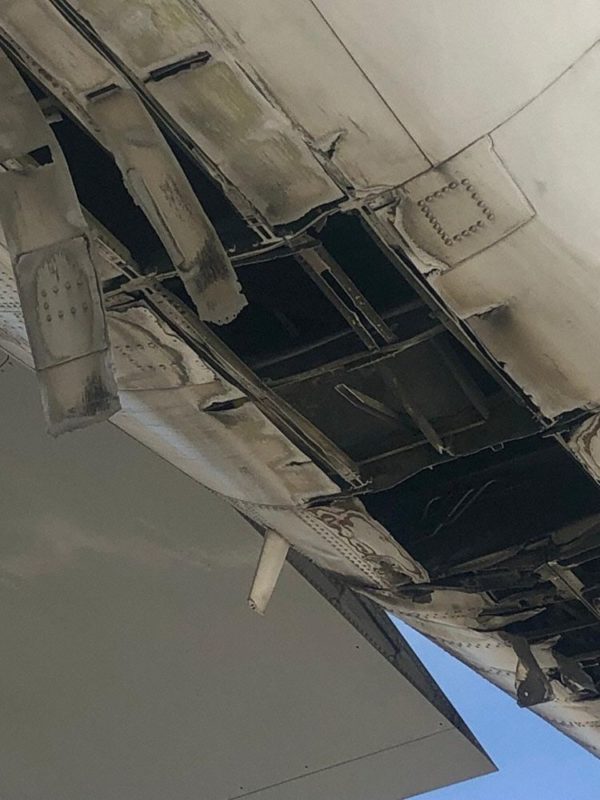
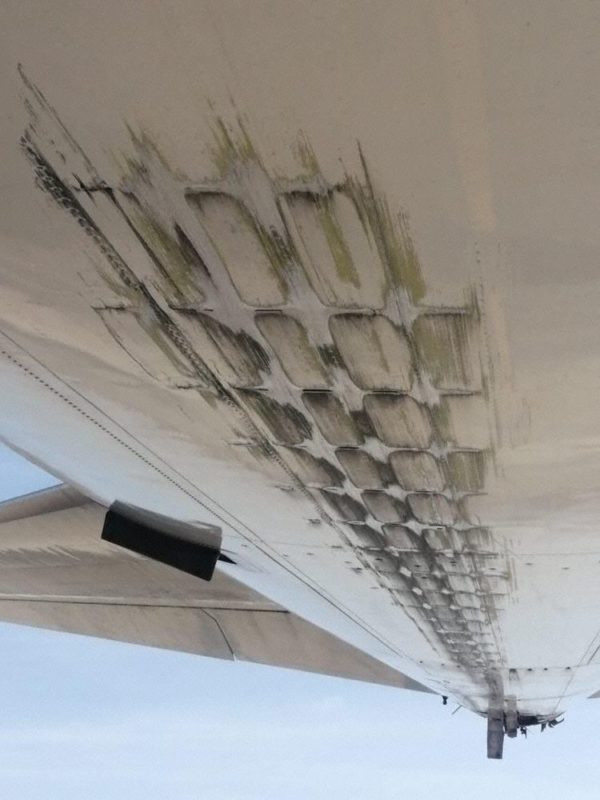
MyCargo Boeing B747-400 (TC-MCT) experienced tailstrike on departure at Damman, RSA. Flight #SV919 to Zaragoza diverted to Jeddah. pic.twitter.com/LnbC9MudXT
— JACDEC (@JacdecNew) February 2, 2020
The aircraft will remain on the ground until an assessment of the damage is completed and appropriate repairs are undertaken.
An investigation will likely be launched as to why the aircraft struck its tail during its rotation.
Saudia Airlines and ACT Airlines (MyCargo Airlines) has been contacted by us for a statement regarding this incident.





“A-man
… Additionally, since this airplane is not operating with a pressurized main fuselage, holes in the skin are not as big of a deal as they would be for a passenger configuration. There is no chance of blowing an aft pressure bulkhead.”
A quick look at the schematic shows an aft pressure bulkhead, in addition if there was no aft pressure bulkhead there would be nothing stopping the cargo from breaking the evelvator jackscrew and APU.
All 747’s fly pressurized, including freighters. The pressure bulkhead is in front of the tail structure, so the strike area is in an unpressurized part of all 747’s
There’s really just one cause of a tail strike, and that’s over-rotation. There are several things that could contribute to the problem; it could be pure pilot error, but my guess would be that loading contributed to the problem. Maybe someone miscalculated weights somewhere, or entered the wrong information.
Most of the people shrieking that the plane should have immediately landed do not know what they’re talking about. It seems likely that the flight crew properly assessed the situation and made a reasonable decision on where to divert, burning enough fuel in the process that they did not need to dump fuel. It’s easy in this kind of situation to create an even bigger emergency by panicking.
Fuck off Jack Casey, I hope you have a monkey’s brain.
Ignore the trolls. They’re only here for the responses they can generate.
Jack Casey, someone should wack on ya Facey you wanker.
These human being called jack casey … can’t you grab the comments and just shut up … must you boast around and show people that you know English??🧐😌
Hey Jack. You are missing the bigger picture as the comments are quite valid
Who the hello is this Jack Casey….?!. Seems to be obsessed with correcting everyone’s opinion…..?!. What’s your input in this subject…..zero……!!!!
That was very risky for pilot knowing the problem still went ahead and flew 2 hrs plus. In the first place he wasn’t supposed to fly. God help us
Maybe diverted so far for easier cheaper repairs
Safer to burn off burn off excessive fuel weight.
I am not a pilot.
But surely returning immediately
would have been the right decision.
For all the pilot knew….there could
have been a gaping hole in the
fuselage.
… There WAS a gaping hole in the fuselage. There is a lot more going on than is immediately obvious to those who are not acutely involved in the engineering of this plane. As stated below, fuel weights are possibly a major issue and it is entirely probable that re-routing to nearby airport (as was done) is part of the operating manual for this aircraft. Additionally, since this airplane is not operating with a pressurized main fuselage, holes in the skin are not as big of a deal as they would be for a passenger configuration. There is no chance of blowing an aft pressure bulkhead.
Too many pilots taking too many risks. If the pilot knew the tail section had clipped the runway on take off why on earth didn’t he request a turn around and landing at the airport of origin to at least assess the damage instead of risking the tail section falling off during the flight to another airstrip. If there were passengers on that plane instead of cargo would he have made the same decision….after all its the pilot who makes these decisions during any flight. Maybe the airlines should be checking the competency of their pilots tó be able to make the right decisions when incidents occur during flight.
The pilit should come back and land in his departure airport rather than flying for 2 hours and 50 min to jeddah
You just read the word ‘pilots’. You are not a smart, capable man.
How were the photos taken?
After the aircraft landed.
ACT Airlines. Go figure.
How this could happened to the Queen of the skies. Unbelievable!🤯🤯🤯🤯🤯
Why divert to another airport averagely 3hours away when you can simply perform TOGA. (TAKE OFF AND GO AROUND). Such decisions have killed so many before!!!! They were supposed to have requested the flight controllers to turn back IMMEDIATELY. PERIOD!!!!!
Its not that simple. You wouldn’t want to land with that much fuel in the tanks with a plane that appears to be overloaded to begin with. You could dump the fuel, but that presents problems as well. My point is that its very easy to arm chair quarterback this situation. I can almost guarantee that someone looked at the damage in flight via another aircraft. There was an assessment done. The result of that is to land at an airport that is not as busy and to burn as much fuel as possible to prevent a catastrophic failure. Furthermore you can see by looking at the pictures that the structure of the plane is intact. Some panels got ripped off that’s really it. There is not wrinkles in the sides or very visible damage outside of the impact area.
Too much fat people in Back.
The concept of ‘cargo plane’ ought not be such a mystery. You ought to be ashamed.
0 people. A freighter is 100% cargo
A likely cause is if they did not have the correct weight set in the flight computer. A significant error showing the aircraft to be lighter than it actually is would cause a lower rotation speed. If they then try to force it into the air at too low a speed for the actual weight they will rotate to a higher angle than normal before the plane will lift off. This could be related to the information from the loadmaster or the pilots imputing data incorrectly.
What thought process allowed your brain to select the word ‘imputing’, which has nothing whatsoever to do with the context of your statement? Weird…you’re not actually smart, are you?
To steap climb wrong flap setting to much weight in the back
Too, steep, too (again). Master English at a third-grade level…and then boast of how smart you are.
What if a cargo load move or roller Bach at the take of??
Does ‘roller Bach’ mean something to your brain? Is it a song along the lines of ‘Roll Over Beethoven’?
Loadmaster will loose his license.
Lose, stupid. The common word loose means not tight.
Is there anything but pilot incompetence that could cause such damage? This is a regular B. 747 (rather than 747-X) and thus doesn’t have the flight assistant firmware onboard, this shouldn’t be susceptible to issues like the two downed planes did, if my knowledge serves me well…
Your knowledge is flawed, because you’re too incompetent to discern the numbers 3 and 4. What a piece of work you must be.
I’ll bet you never, ever prevail over other men…at anything.